

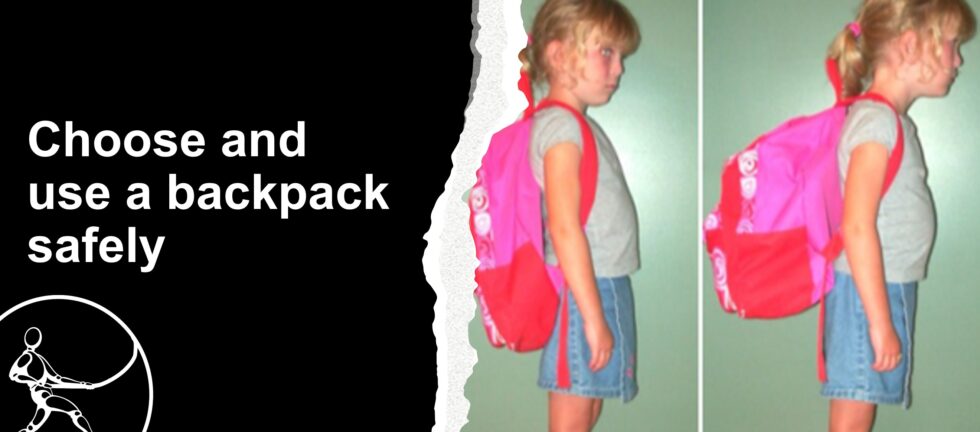
As kids head back to school, backpacks are once again part of the daily routine. While carrying a backpack is a normal part of school life, the way a backpack is designed, loaded and worn can make a meaningful difference to how comfortable it is to carry.
So, what should parents, schools and health and safety professionals be looking for?
Choose the right backpack
Start with the backpack itself. Look for one that is relatively lightweight, with comfortable, padded shoulder straps that do not pinch or dig into the shoulders. Ideally, the backpack should also have a waist strap and a chest strap, both of which can help keep the pack positioned close to the body and distribute the load more effectively.
A well-designed backpack does not need to be complicated, but it should fit the child rather than simply being a smaller version of an adult backpack.
Use both shoulder straps
Once the backpack has been chosen, make sure it is being worn properly. Children should be encouraged to use both shoulder straps rather than carrying the backpack over one shoulder. Where the backpack has waist and chest straps, these should be tightened enough to keep the pack comfortably positioned against the body. (Yes, I know, not cool. But at least get them to feel how different a heavily loaded pack feels with and without the straps, so they might choose to strap up when they’ve got a really heavy load.)
Using both shoulder straps helps distribute the load between the shoulders and back and avoids placing all of the load on one side of the body. It can also help prevent the backpack from hanging too far away from the back, which can increase the tendency to lean forward while carrying it.
Keep the load manageable
The weight of the backpack matters, particularly when it is carried for long periods or over significant distances. A commonly used guideline is to keep the backpack to around 10–15% of the child’s body weight. For example, an 80-pound child would ideally carry no more than about 8–12 pounds, including the backpack itself.
This is a more useful guideline than a precise threshold at which a backpack suddenly becomes unsafe. It provides a practical way to think about how much children are being asked to carry.
Take a look at the posture of a child carrying a particularly heavy backpack: a forward lean and head thrust may develop as the child tries to compensate for the load. Compare that with a child carrying a lighter backpack, who can maintain a more natural posture. (The child in the images above is now 29 years old. Not much has changed with backpack design in 2 decades!)
There are several simple ways to keep the load weight down. Water bottles can be filled at school rather than carried full from home, children can carry only the books and equipment they actually need that day, and electronic versions of textbooks can be used where they are available and appropriate.
It is also worth getting into the habit of reloading the backpack every day rather than allowing unnecessary books, papers and equipment to accumulate.
Put the heaviest items closest to the back
How the backpack is packed can be almost as important as how much it weighs. The heaviest items should be placed closest to the child’s back, with lighter items in the outside pockets.
Keeping the heavier items close to the body helps keep the centre of mass of the backpack closer to the child’s own centre of mass, reducing the tendency for the load to pull the child backwards and encouraging a more natural carrying posture.
Minimize carrying time
Even a well-designed and properly loaded backpack still has to be carried, so reducing carrying time can be an effective way to reduce the overall demand.
Where lockers are available, encourage children to use them to store books, equipment and even the backpack itself during the school day rather than carrying everything from class to class. The same principle applies at home: there is little benefit in carrying items that are not actually needed for the next part of the day.
How serious is the problem?
It is tempting to describe heavy backpacks as a major health hazard, but the evidence and the practical situation are more nuanced than that.
Back, neck and shoulder discomfort is relatively common among school-aged children, and backpack use may contribute to that discomfort. However, carrying a backpack is not generally considered likely to cause permanent long-term injury in an otherwise healthy child.
The more interesting question may be what happens when carrying a backpack becomes uncomfortable enough to change a child’s behaviour. If a child starts opting out of sports or other activities because they do not want to carry their equipment, or if a child who already has back or shoulder discomfort is avoiding activities they would otherwise enjoy, the concern may be less about permanent tissue damage and more about the potential impact on long-term activity and lifestyle choices. That is an important distinction. We do not need to dramatize backpack use to recognise that comfort matters, particularly when discomfort starts to affect what children are willing to do.
What can parents do?
Perhaps the simplest advice is to lead by example. If Mom carries a large, heavy laptop bag slung over one shoulder, she may have a hard time convincing Joey that he needs to wear his backpack properly over both shoulders. Children notice what adults do, not just what we tell them to do.
So as the new school year begins, take a look at all the backpacks in your house, how they are packed, how they are worn and how long they are carried. A few simple changes can make carrying school equipment more comfortable, without turning the backpack into something to be feared.