

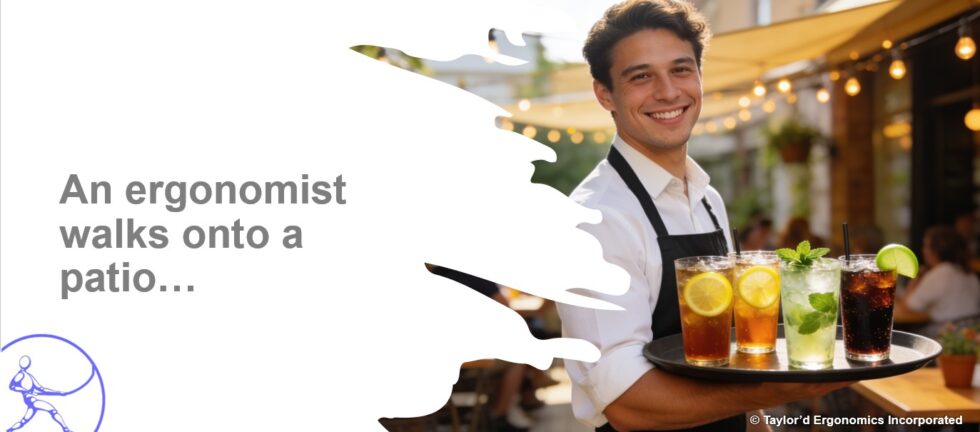
Like many professionals, I have trouble switching off the “ergo” part of my brain. This summer, while enjoying a few restaurant patios, I’ve found myself studying… serving trays.
Most restaurants use very basic serving trays. Servers typically carry them by placing a flat palm underneath while resting part of the tray on the forearm. This is actually a clever ergonomic strategy. By resting the tray on the forearm instead of supporting everything in the hand, the load is brought closer to the body and shared over a larger area. The shoulder and hand don’t have to work quite as hard.
The trade-off is that all of the weight is carried on one side of the body, creating an asymmetrical load. The benefit, however, is that the other hand remains free to serve food and drinks.
But is this the best way to carry a tray at home?
Keeping the load close to your body is always important, but supporting everything on one arm might not be the best choice if you’re hosting a large gathering with heavy dishes or glassware.
A tray with handles allows you to use both hands while keeping the load close to your body. Even better, if a side table or dining table is available, set the tray down before distributing dishes. Breaking the task into smaller steps is often easier on the body than carrying and serving everything in one continuous motion.
It’s also worth thinking about your route before you lift the tray. Will you need to squeeze through a doorway? Walk around children or enthusiastic dogs? Climb stairs?
Trying to open a door with your elbow while balancing a tray of cocktails is rarely a winning strategy. Likewise, if you need to use stairs, it’s wise to carry a smaller load and keep one hand free for the handrail.
So, what makes a serving tray “ergonomic”?
A friend recently told me that her late mother collected serving trays; she found trays in almost every room of the house. Perhaps her mom had different trays for different occasions. I can’t help thinking that maybe she was searching for the most “ergonomic” version.
After my exhaustive (though thankfully not exhausting) field research at local patios, here are my thoughts.
For one-handed trays
Keep it light. A lighter tray reduces the effort required, even on the return trip to the kitchen. If you’ll often carry the tray empty, a handle lets you carry it at your side, giving your arm and shoulder a welcome change of posture.
Keep it close. Choose a tray that rests comfortably against your body. The closer the load is to your spine, the less effort your back and shoulder muscles need to generate.
Choose an appropriate size. For one-handed carrying, the tray shouldn’t extend so far beyond your hand and forearm that it becomes difficult to balance comfortably.
Prevent sliding. A raised rim and a non-slip surface can prevent spills caused by an unexpected stop, quick turn, or an encounter with kids or pets.
Keep it rigid. As a teenager, I worked in a restaurant that used beautiful wicker serving trays. Unfortunately, they sagged under heavy loads. My attention shifted from watching where I was going to preventing spills—not an ideal trade-off in a busy restaurant.
For two-handed trays
All of the above tips still apply. Keep the tray light, rigid, and close to your body whenever possible. Handles, a raised rim, and a non-slip surface are all worthwhile features.
Don’t overload it just because it fits. A larger tray isn’t always better. It may hold more plates or drinks, but it can also tempt you to carry more weight than is comfortable or safe.
Choose comfortable handles. All four fingers should fit easily around each handle, and the handles should be rounded and smooth so they don’t dig into your fingers when the tray is heavily loaded.
One of the fun things about being an ergonomist is that everyday objects become case studies. Whether it’s a serving tray, a shopping cart, or a suitcase, good design can make work easier—and poor design usually makes itself known by the end of the day.
So next time you’re enjoying a patio, take a look at how the servers carry their trays. You might just start seeing ergonomics everywhere.
Cheers!