

When we talk about lifting, most people picture warehouses, construction sites, or manufacturing environments. We think about boxes, pallets, and maybe even lifting load limits. But for many people, the most frequent and most physically demanding lifting we do doesn’t happen at work at all.
It happens at home, with family.
Family Day prompts us to remember that caring for the people we love often involves physical work. You lift a toddler into a car seat. You carry a sleeping child up the stairs. You help an aging parent out of a chair. You haul laundry baskets, groceries, sports equipment, and suitcases. These tasks don’t come with job hazard analyses or lifting training—but they place real demands on your body.
From an ergonomics perspective, family life is full of high-risk lifts.
Why Family Lifting Is Different
Lifting items at home never looks like “work” the way you’d expect it “at work.” Boxes don’t have handles, loads are not labelled, and starting positions can be really awkward.
Children squirm. Pets resist. Parents need support, not speed.
Lifts often happen:
- In tight spaces (car seats, bathtubs, stairs)
- From awkward heights (floor level or deep reaches)
- When we’re tired, distracted, or in a hurry
Biomechanically, these conditions increase the loads on your spine, joints, and muscles. The likelihood of sudden movement adds to the risk.
And yet, these are the lifts people are least likely to think twice about.
Lifting Out of Love
One of the most human aspects of family lifting is willingness. We are often far more willing to strain our bodies for the people we love than for a task at work.
- A parent doesn’t hesitate to pick up a child who’s fallen.
- An adult child doesn’t think twice before helping a parent stand.
- A caregiver doesn’t stop to “reposition the load” or “get a better grip” when someone needs help now.
This instinct is natural—and admirable—but it’s also where ergonomics has something valuable to offer. Ergonomics isn’t about refusing to help. It’s about finding safer ways to do the helping that family life requires.
Everyday Family Lifts, Through a Biomechanics Lens
Consider a few common examples:
Car seats:
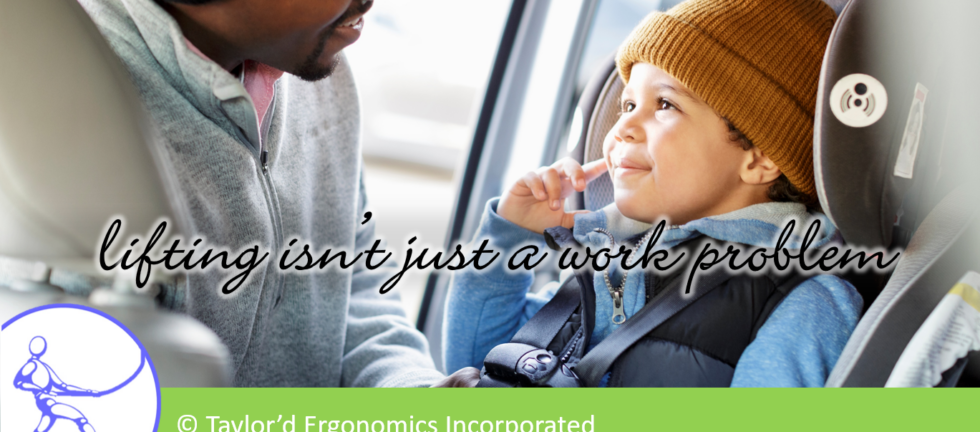
Lifting a child into a car seat often involves twisting, reaching forward, and lifting with arms extended—a very demanding posture for the lower back. Letting toddlers clamber into their own seats would be the first “ergo” intervention to consider. Beyond that, make sure that you park so the door can fully open, and hug the “load” close to your body, as you climb into the vehicle. Choosing a vehicle with easier access to the kids’ seats can also be key – hence the popularity of the minivan.
Laundry baskets:
Overfilled baskets lifted from the floor encourage rounding of the back and high compressive forces. Smaller loads, shelves or tables, and splitting the task into two trips can reduce strain with very little added time. If your path includes stairs or doors, baskets that are designed to be carried on the hip leave the other hand free. Amongst our team, broken laundry basket handles are a pet peeve, so an upgrade there might be considered “ergonomic.”
Taking out the garbage:
We’ve all been guilty at some point of loading too much weight into the bag, so managing bag weight is the first step towards an ergonomic experience in your house, as well as for the waste collector. Maintain clear access to the bins to minimize reaching, and keep a clear path between the storage location and the pickup spot. Big wheels can certainly ease the strain of carrying or dragging bags or bins.
These aren’t “rules.” They’re small adjustments that acknowledge how bodies work.
What Ergonomics Really Brings to Family Life
At its core, ergonomics asks a simple question: Is there an easier way to do this?
Applied to family life, that question becomes a form of care:
- Can the task be shared?
- Can the environment be adjusted?
- Can the load be reduced, raised, or supported?
- Can we use legs instead of backs, or get closer to the load instead of reach?
Sometimes the best ergonomics intervention at home isn’t a technique—it’s another person stepping in to help.
Family Day Reminder
On Family Day, celebrate connection, care, and responsibility for one another. The physical side of that care is often invisible—but it matters.
Lifting isn’t just a work problem. It’s a life problem. And ergonomics isn’t about compliance or checklists—it’s about helping people take care of themselves.
That’s a lesson worth carrying home.