

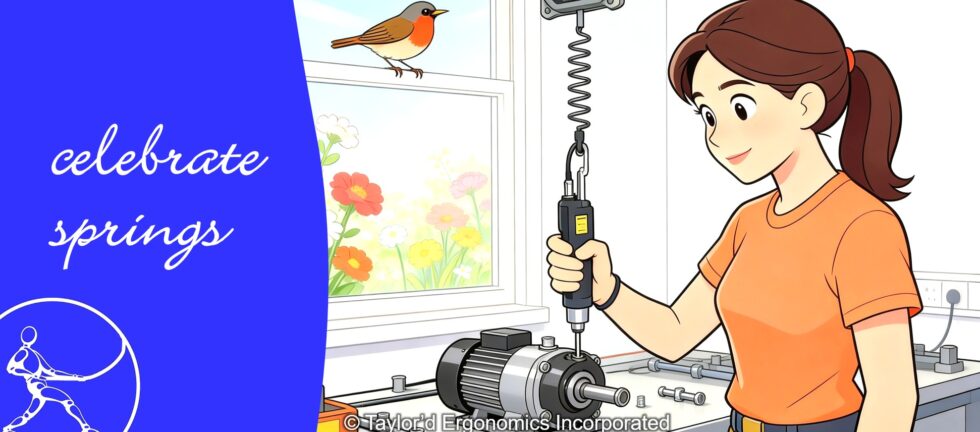
If you’ve been following along, you know I can’t resist a good pun. Now that spring has sprung, it’s a good time to highlight how mechanical springs are used to support ergonomic design.
In ergonomics, springs are often used to control force, maintain optimal working height, absorb vibration, or assist movement. Each of these functions addresses common physical hazards such as high force demands, awkward postures, repetition, and vibration exposure.
- Tools
Spring balancers are used in manufacturing to suspend tools, effectively offsetting their weight. This reduces the reach distance and eliminates the need to repeatedly pick tools up from surfaces. It also reduces the effort required to hold the tool and minimizes sustained shoulder and forearm loading—two common contributors to musculoskeletal disorders (MSDs).
Did You Know?
Spring balancers can be tuned to match the exact weight of a tool, allowing the tool to “float” in place—reducing both lifting effort and awkward postures.
Return springs are often used in handheld tools like pliers, scissors, or crimpers to automatically return the tool to an open position, minimizing the grip force and repetitive finger effort.
Vibration-damping handles in chainsaws and other heavy power tools use springs to reduce the transmission of vibration to the user, helping to reduce exposure to hand-arm vibration—a known risk factor for hand-arm vibration syndrome (HAVS).
- Furniture and material handling equipment
Gas lift springs are used in office chairs and adjustable desks to provide smooth, controlled height adjustments. They allow the user to adjust the seat height for foot support, or raise it to optimize keyboard position, reducing strain on the back, neck, and shoulders. Similarly, backrest tension springs allow the user to comfortably recline, supporting the back throughout the workday. Counterbalance springs are also used in manually adjustable sit-stand desks, allowing users to raise and lower the work surface with minimal effort.
Spring-loaded carts, used in laundry, food services, and warehouses, keep items near waist level as they are loaded or removed, reducing the need for bending or reaching. Spring-loaded lift tables raise or lower a pallet of boxes as they are loaded or unloaded.
- Personal Protective Equipment (PPE)
Passive exoskeletons are wearable devices that use springs, elastics, or dampers to support specific joints, such as the back, shoulders, or legs . They can reduce physical strain during lifting, bending, or overhead work.
- Sleep and comfort systems
Pocket or coil springs are used in mattresses to individually follow the body’s contours, offering personalized support and better pressure relief for improved posture. Quality sleep surfaces can influence recovery between work shifts, particularly for workers performing physically demanding tasks.
- Doors
Springs are commonly used in door closers and counterbalanced doors to control movement and reduce the force required to open or close heavy doors. In industrial settings, this can reduce shoulder strain and help prevent sudden door movement injuries.
Springs play an important role in ergonomic design by offsetting weight, maintaining optimal working height, absorbing vibration, and assisting movement. These functions reduce physical demands on workers, improve control of tools and materials, and help prevent fatigue and injury.
So, while we all appreciate the “spring” associated with flowers popping up and robins singing, we can also take a moment to appreciate the “other spring” that might make our jobs easier!